the meaning of life
I don't want to say too much more about the production, for
fear of spoiling the suspense of the plot—which as presented
here has a thoroughly enjoyable way of unfurling around you,
changing shape and expanding scope as you begin to comprehend
more and more of the context. I will say that overall, the
play has a more accessibly powerful message about human life
than Shakespeare's own romances do—though on mature reflection,
perhaps simply because it's a little less multifaceted and
indirect. You'll leave the theater a wiser person, one less
inclined to avoid opportunities to realize your highest potential
when they come your way, than when you entered it. And that
can hardly be a bad thing, can it?
Williamson also makes spendid use of the permanent technical
staff OSF provides. Set (Robert Blackman), costumes (Deborah
M. Dryden), special effects were are all of the highest polish,
truly top notch. This attention to detail pays special dividends
when Segismundo suddenly awakens from his life of exile into
the world of the court: you also gasp at the lush, unspeakably
ornate realization this world attains on the Ashland stage.
the myth of matriarchy
The less said about the 2001 OSF Tempest, the better—lest
the pleasures of composing an all-out pan alienate my Ashland
contacts. And truly, this Tempest is not all that bad—just
unpardonably dull and lacking in inspiration.
The sad part is, it would have required boatloads of inspiration
to pull the director's concept off. For Associate Artistic
Director Penny Metropulos has gone and given my character
of Prospero a sex-change operation: he is now she, and goes
by the title "Duchess of Milan," however unmetrical
it may be (and despite the fact that she is still addressed
as "Sir" sometimes).
And what a woman! Demetra Pittman plays Prospero as a mother
possessed of a profoundly good if bleeding heart, her eyes
full of tender concern for the creatures around her—and
an unconditionally nurturing companion for Miranda her daughter.

sin grandly, or not at all
Now maybe this kind of conception could work if Metropulos
had gone Williamson's route and first translated The Tempest
into another language, then changed a good deal of the plot
and even the ending to make it responsive to the brave new
world she'd like to see in it. This is the route that the
Martiniquan poet Aimé Césaire (who just last
week finally retired as mayor of Fort de France after 55 years)
followed in his anti-colonialist Une Tempête,
to international critical acclaim. But not having the courage
of such convictions—or the awesome talent required to
pull them off—Metropulos merely emasculates the play,
leaving little wonder that the production falls flat
|
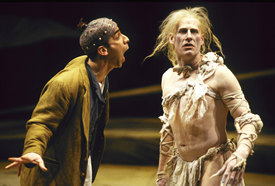 Trinculo (U. Jonathan Toppo, left)
and Caliban (John Pribyl) in the Oregon Shakespeare Festival's
2001 production of William Shakespeare's The Tempest. Photo
by David Cooper.
Trinculo (U. Jonathan Toppo, left)
and Caliban (John Pribyl) in the Oregon Shakespeare Festival's
2001 production of William Shakespeare's The Tempest. Photo
by David Cooper. Nevertheless, handsome performances were turned in by John
Pribyl as a uniquely articulated Caliban, the precision and
interpretive lilt of whose line readings never failed to amaze.
Cristofer Jean was even more showy, if slightly less substantial
as a fey, strikingly featured Ariel—the star of several
lushly decorative, vaguely Asian tableaux that Scenic Designer
William Bloodgood and Costume Designer Christina Poddubiuk
recompense us with.
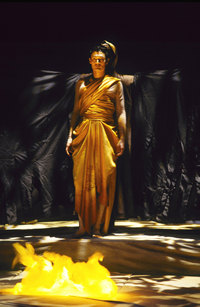
Ariel (Cristofer Jean) and an island
spirit (René Thornton, Jr.) in The Tempest. Scenic design
by William Bloodgood; costume design by Christina Poddubiuk;
lighting design by Robert Peterson. Photo by David Cooper.
Laird Williamson: remember that name
My advice to Ashland: the next time you think of doing The
Tempest or another romance—and making it the longest-running
play in your repertory season—you'd best put Laird Williamson
in charge of it, instead of relegating him to late (Pericles)
or early (Life is a Dream) half-season wonders. He'd
do the job properly, and put Ashland on the map as the place
to go in the new millenium to see Shakespeare's romances brought
to life—as he already seems to be doing with the Denver
Center Theatre Company, which is making the most use of his
talents these days (to the raves of a local reviewer, obviously
delighted with Denver's good fortune to have him there, in
1999
and 2000).
Other festivals—and playgoers around the world—take
note: an opportunity at a Williamson production is not to
be missed. I, for one, will be on the lookout for his next
venue. Those of you who can, be sure to reserve your tickets
and get to Ashland to see this Dream before it goes
dark July 8. I guarantee—you won't regret it.
|